Report
In Yemen, Flight From Fighting Can Cost a Child the Classroom
Muneer Farie sells socks instead of studying after his family fled fighting in Taiz. New displacement figures show the wider upheaval—but not how many children have been pushed into work.
Story trackerDay 1
1 report27 outlets53 sources
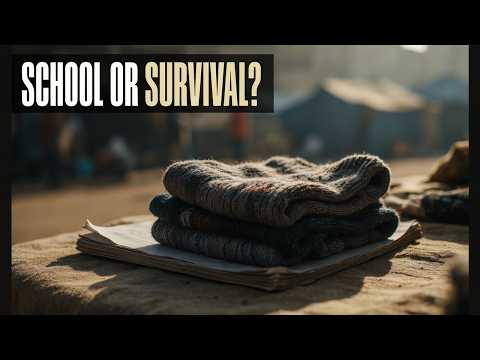
Video in its original language
Transcript · LOADING
What does a family give up when fleeing the fighting also means its children must help pay for survival? For 13-year-old Muneer Farie, the answer is not just his village in Yemen’s Taiz governorate. It is time in a classroom. The Guardian reports that he and his brother now sell socks and other inexpensive goods outside a displacement camp instead of studying. Their father, Ghaleb Farie, says he asked them to work because the family needs the money to get by. 1
Muneer had hoped to become the first teacher in his farming family. Before they fled their village in al-Wazeyah district, he could hear explosions and gunfire from his classroom. Fighting drew close; the family left. His ambition has not been measured away by a humanitarian survey, but his days have changed: lessons have given way to market work. That is one family’s account, not proof that every displaced child has taken the same path. 1
Key facts
What the displacement count shows
Renewed fighting between Houthi and government-side forces has driven families into camps in southwest Yemen. The International Organization for Migration’s latest available estimate, dated September 28, counts 145,308 people in 24,218 households displaced across eight governorates since the West Coast escalation began in June. A week earlier, its comparable count was 129,438 people in 21,573 households. The difference is 15,870 people and 2,645 households—more than a 12% rise in the person count in one week. 1 2
Those boundaries matter. The September 28 total is not a count for Taiz alone, and it does not mean all 145,308 people fled during September. Nor can it tell us how many families are staying in Muneer’s camp. It does show that, as of the latest count, displacement across the affected governorates was still growing rather than giving way to a general return home. 2
Other figures describe earlier snapshots or different reporting windows. The Guardian reported a then-current 125,000 displaced people on September 17; that figure has been overtaken by the later IOM count. A separate September 25 estimate described nearly 130,000 people displaced over the preceding three weeks, including about 71,000 children. It measures a recent period, not the cumulative movement across eight governorates since June. Counting those 71,000 children as children who left school—or adding them to IOM’s total—would answer a question the figures were not designed to answer. 4 2 32
Disrupted school is not dropout
As reported September 15, more than 137,000 school-aged children faced major disruption to their education amid the renewed fighting. That is evidence of a broad interruption, but not a verified tally of permanent dropouts or children newly entering work. In Taiz, some children have lost access to classes while others, like the Farie brothers, are described as working to help meet family needs. There is no established count of how many displaced children have begun working in this escalation. 28 1
Yemen’s education crisis also predates the latest fighting. An April 2026 Yemen-wide report put the number of children out of school at 3.2 million. The precise operational definition behind that older estimate has not been independently established here. It must not be described as 3.2 million children newly removed from classrooms this month, or added to the September figure for children whose schooling has been disrupted. One number concerns a longstanding national problem; the other describes disruption amid renewed fighting. 26 30 28
The pressure on families extends beyond whether a school is open. In Taiz, blocked roads have disrupted travel and trade and made basic goods more expensive, according to The Guardian’s reporting. For a household already living in a camp, that makes the need for immediate income harder to set aside. The available account does not quantify the particular closures, their duration or the price increases, so it cannot establish exactly how much those pressures contributed to Ghaleb Farie’s decision. What he does say is that his sons’ work is necessary for the family to survive. 1
Known
Unknown
- How many newly displaced children are working, or when the brothers can resume school.
Next
- Whether the family can return safely and the boys can get back to lessons.
The figures establish the scale of movement and the reach of educational disruption. Muneer’s story shows something narrower and more immediate: when a family loses its home and needs cash, a child’s working day can replace a school day. Neither the numbers nor his experience tells us when that trade-off will end. 1 2 28
As aired 9 lines
- Thirteen-year-old Muneer Farie sells socks outside a displacement camp instead of studying. His family fled fighting in Yemen’s Taiz governorate, while the latest displacement count across eight governorates has reached 145,308 people. What do the figures tell us about children losing school—and what remains unknown?
- Muneer and his brother sell socks and other cheap goods to help their family survive in the camp. Their father, Ghaleb Farie, says he asked the boys to work because the family needs the money. Muneer had hoped to become the first teacher in his farming family. Before they fled their village in al-Wazeyah district, he could hear explosions and gunfire from his classroom. Now work has taken the place of lessons for both brothers.
- The family fled as fighting drew close to its village. Renewed clashes between Houthi forces and Yemen’s government-side forces have broken a period of relative calm in the southwest and driven families into camps. But the count of people uprooted reaches well beyond Taiz: it covers eight governorates affected by the West Coast escalation that began in June.
- The September 28 count is 15,870 people and 2,645 households higher than the comparable count one week earlier. That is a rise of more than twelve percent in the number of displaced people. It shows displacement was still growing through September 28; it does not say all 145,308 people fled during September, or that they are all in Taiz. There is no established count for Muneer’s camp.
- Earlier figures describe earlier snapshots or different periods, not competing totals for the same date. A September 17 account used a then-current figure of 125,000. A separate estimate released September 25 covered the preceding three weeks: nearly 130,000 people displaced, including about 71,000 children. That three-week window cannot be substituted for the cumulative eight-governorate count since June. And the roughly 71,000 children displaced cannot automatically be counted as children who stopped attending school.
- As reported September 15, more than 137,000 school-aged children faced major disruption to their education amid the renewed fighting. Some children in Taiz cannot reach classes; others leave lessons to earn money. But disruption is not the same as permanent dropout, and that figure does not tell us how many children have begun working. Muneer and his brother are two specifically described cases, not a measure of child labour across Yemen.
- Schooling was already in crisis before this escalation. An April Yemen-wide estimate put 3.2 million children out of school, after years of civil war had interrupted education. The precise definition behind that older measure has not been independently established. It is not a count of children newly pushed out of class this September, and it must not be added to the figure for children facing disruption from the new fighting.
- Displacement brings other pressures alongside the loss of a classroom. In Taiz, blocked roads are disrupting travel and trade and making basic goods more expensive. That raises the cost of meeting immediate needs for families already forced from home. The specific roads affected, how long they have been blocked and the size of the price rises have not been established here.
- The answer to how many newly displaced children have moved from school into work is still unknown. The education-disruption and child-displacement figures measure different things; neither provides that count. For Muneer and his brother, work has replaced study, and there is no established date when they can return to school or when their family can safely go home.
Sources
53 sources27 outlets7 wire copies
International Organization for Migrationiom.int15
- Over 145k Now Displaced in Yemen, 16,000 Increase in Past Week
- Yemen — Rapid Displacement Tracking Update (20 – 26 September 2026) | Displacement Tracking Matrix
- 20260915_Yemen IOM DTM_Flash Updated_Displacement Caused by Escalation in the West Coast_No3
- Yemen Displaced Top 104,000 as IOM Calls for Urgent Action
- 20260916_Yemen IOM DTM_Flash Updated_Displacement Caused by Escalation in the West Coast_No4
- 20260913_Yemen_ IOM DTM_Emergency Displacement from West Coas_V3
- Yemen - Displacement Caused by Escalation in the West Coast — Update Dataset #9 (21 September 2026) | Displacement Tracking Matrix
- New IOM Data: Nearly 130,000 Displaced in Yemen Due to Escalating Conflict
- Other | Displacement Tracking Matrix
- Situation Report | Displacement Tracking Matrix
- Escalation in the Middle East and Beyond — Special Focus on Yemen (07 June - 18 September 2026) | Displacement Tracking Matrix
- 20260914_Yemen IOM DTM_Flash Updated_Displacement Caused by Escalation in the West Coast_No2
- Yemen - Displacement Caused by Escalation in the West Coast — Update Dataset #6 (18 September 2026) | Displacement Tracking Matrix
- KSrelief and IOM Join Forces to Provide Safer Shelter and Vital | IOM Yemen
- IOM Spokesperson: Numbers of Displaced in Yemen Reaches Nearly 94 | IOM Regional Office for Middle East and North Africa
The Guardiantheguardian.com4First
- First reported
- Children forced to give up school for work as fighting upends daily life in Yemen
- ‘We left everything behind’: 125,000 people displaced as war reignites in Yemen | Yemen
- ‘I hadn’t seen people smiling until I arrived in the UK’: one man’s harrowing journey from Yemen to safety | Yemen
- ‘I’m afraid they’ll bomb the cafe where I work, or bomb me’: a day in the life of a 12-year-old boy in Gaza | Global development
Al Jazeera Mirroredgeone.app1
BBC Sportbbc.com1
BBC Sportbbc.co.uk1
CRBC Newscrbcnews.com1
European Express Newseuropean.express1
Middle East Monitormiddleeastmonitor.com1
News Divenewsdive.net1
Peace Newspeacenews.net1
Quanta Reportquanta.report1
Showcaseprofitpickpath.com1
theguardianwings.pages.dev1Unverified host
Yemen Online |yemenonline.info1
Zonebourse Suissezonebourse.com1
منصة أطفال اليمنyemenschildren.net1
Source map
Follow the evidence behind this report. The map shows its connections; the links below open the sources cited in this article.
Source map loads as you read.
Revision log
- r1First published.