
Conflict
Cessna Veers Into Hovering Police Helicopter at Carlisle, Killing ER Doctor
A landing Cessna veered into a hovering State Police helicopter at Carlisle Airport, killing ER doctor Paul Sokoloski and injuring two troopers. Investigators say there is no immediate explanation.
Transcript · LOADING
Story trackerDay 1
1 report9 outlets11 sources1 video
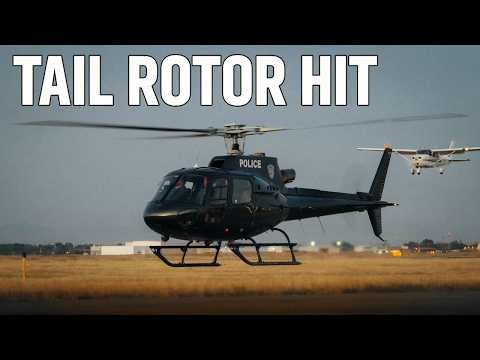
One is the number that matters most here. One small airplane, one hovering helicopter, one pilot who did not come home — and two troopers who did, hurt, from a collision that should not have happened at a quiet county airport on a summer evening 34711. Everything investigators have said since points back to that brutal asymmetry: a routine landing attempt that ended in wreckage, and a question with no answer yet about why the airplane turned into the helicopter 23.
On Wednesday, Aug. 19, 2026, at about 7 p.m., a single-engine Cessna 150 attempting to land at Carlisle Airport in Cumberland County, Pa., veered off the runway line and struck a hovering Pennsylvania State Police Bell 407 helicopter 3711. The plane carried only its pilot, who was killed 3711. The helicopter carried two state troopers, who were injured 4910. Both aircraft came down on airport property, and the Cumberland County Coroner's Office pronounced the pilot dead at the scene 67.
The pilot was identified by the coroner's office as Paul Sokoloski, 57, of Hershey 67. He was an emergency room doctor with Penn State Health and an assistant professor at Penn State College of Medicine, described by his hospital as an important part of its emergency medicine team 7. That biography is why the crash traveled so fast beyond Cumberland County: Sokoloski was not an anonymous weekend flyer in the public telling, but a physician colleagues knew, killed in an aircraft he flew alone 67.
Collision With No Immediate Explanation
PennLive described the impact as a very violent midair collision 4. The language was not hype. A light trainer striking a turbine helicopter at low altitude, near the ground, leaves neither aircraft anywhere to go, and both were wrecked where they fell 3411. The helicopter was a Pennsylvania State Police Bell 407GX, hovering over a grassy area when it was struck 11. The airplane was a Cessna 150 on a landing attempt that turned, for reasons still unexplained, into the helicopter's position 3711.
What makes the sequence so difficult to absorb is that the Cessna had been around the airport, not simply appearing on short final. Flight-path data showed the Cessna circling the airport before the collision 8. Circling is ordinary — pilots circle to space themselves, to look at wind, to get a feel for an unfamiliar field — but here it deepens the puzzle rather than solving it 8. A pilot who had time to orbit had time to see, and yet the landing still ended in a veer that put a small airplane into a hovering police helicopter 28.
The investigator in charge, Aaron McCarter of the National Transportation Safety Board, told reporters on Thursday there was no quick answer for that turn 2. Investigators retrieved data cards from both aircraft for evaluation 2. A second media briefing was scheduled for Friday as the team continued to map wreckage, flight paths and witness accounts 8. The early posture was deliberately narrow: document, recover, download, and resist the pressure to assign cause from the tarmac 28.
The injury language itself tells a story about how early information moves. PennLive initially reported the two troopers as injured 4. ABC News reported they were expected to recover 9. A later NTSB report, dated Sept. 2, described them as seriously injured 10. Those descriptions are not necessarily contradictory — people expected to recover can be seriously hurt — but the shift is a reminder that the first day's reassurance is not a medical record 910. What is consistent across accounts is that both troopers lived through the destruction of their own aircraft, which in a low-level rotor strike is itself remarkable 4910.
There was "not an immediate explanation" for why the small plane veered while landing.
That single sentence should frame everything else written about Carlisle for now. A veer on landing can come from many places — a gust, a misjudged lineup, a control input, a distraction in the cockpit, a medical issue, a misunderstanding about where the helicopter was and where it was going — but none of those possibilities has been established here 2. The NTSB has not offered a cause, and the retrieved data cards have not been described in public as providing one 2. To fill that silence with a theory would be to do the investigators' job worse than they are doing it 28.
There is also what the file does not prove, and honesty requires naming it. The research file dates the crash to Aug. 19, not Aug. 20, and spells the pilot's name Sokoloski, not Sokolowski 346711. It places the crash at Carlisle Airport in Cumberland County and identifies the helicopter as a Bell 407GX over a grassy area, with the Cessna circling beforehand 811. It does not confirm street addresses, airport identifiers, distances from Harrisburg, hover heights, rotor-by-rotor impact sequences, video-frame breakdowns, autopsy dates or prior military service 3411. A careful reader should treat any version carrying those extras as going beyond what the cited reporting establishes 23467891011.
Known
- Cessna 150 landing attempt struck hovering State Police Bell 407 at Carlisle Airport about 7 p.m. Aug. 19. 3711
- Sole Cessna occupant was Paul Sokoloski, 57, of Hershey, an ER doctor with Penn State Health. 67
- Two troopers aboard helicopter were injured, later described as seriously injured. 4910
- NTSB recovered data cards from both aircraft and reported no immediate explanation for the veer. 2
Unknown
- No verified cause for why the Cessna veered while landing.
- No public account yet of final communications, cockpit actions, or mechanical condition beyond recovery of data.
Next
- Whether follow-up NTSB findings clarify the circling flight path and final seconds.
- Whether updated medical and investigative reports revise the early injury descriptions.
The work ahead is unglamorous and essential. Investigators will correlate the recovered data with flight-path traces showing the circling Cessna, with wreckage geometry, with radio and witness material, and with the condition of both machines 28. That correlation is slow because it has to be. A preliminary public report can outline facts without finding fault, and a final determination of probable cause comes much later, after every plausible path has been tested against the evidence 2810. For Carlisle, the only responsible verdict today is the one the NTSB already gave: a very violent collision 4, a respected physician dead 7, two troopers hurt 10, and no immediate explanation yet for the turn that joined them 2.
Sources
11 sources9 outlets1 video
HeyDay News11 video
Inquirer.cominquirer.com1
NBC10 Philadelphianbcphiladelphia.com1
Source map
Follow the evidence behind this report. The map shows its connections; the links below open the sources cited in this article.
Source map loads as you read.
Revision log
- r1First published.