
Conflict · Apache training groundedContinuing story · report 4 of 4
Army Grounds All Apache Training Flights After Fatal Fort Hood Crash
Two Fort Hood pilots died when an AH-64E crashed near Salado, sparking a fire and a fleet-wide pause on Apache training.
Transcript · LOADING
Continuing storyDay 4
4 reports18 outlets23 sources4 videos
Full story- No dated events yet
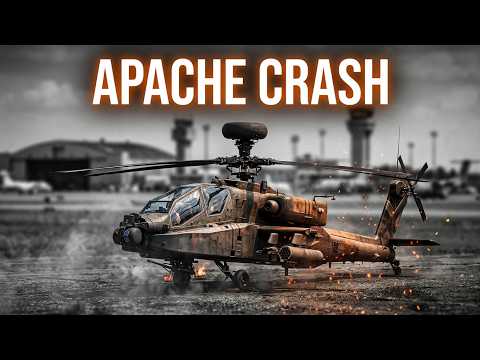 Update 12 Soldiers Killed in Fort Hood Apache Crash Near Salado
 Update 2Apache Maintenance Flight Crashes Near Fort Hood, Killing 2 Soldiers
 Update 32 Dead in Texas Apache Crash: Who They Were and Why Flights Resumed
 Update 4Army Grounds All Apache Training Flights After Fatal Fort Hood CrashYou are here
What changed since our last report
43 hours later
Then
2 Dead in Texas Apache Crash: Who They Were and Why Flights ResumedStill open then
- No public cause, cockpit voice details, or maintenance history has been confirmed in these sources.
- No official explanation for the decision to resume flights is given in the visible resumption report.
We said we'd watch for
- Whether Army investigators release a preliminary cause or safety bulletin for the Apache fleet.
- Whether Fort Hood holds a public memorial or releases additional biographical details about Huey and Olmstead.
Now
Two Fort Hood pilots died when an AH-64E crashed near Salado, sparking a fire and a fleet-wide pause on Apache training.
Now established
- An AH-64E Apache crashed near Salado at about 1:40 p.m. Aug. 12, killing both pilots and starting a fire that forced evacuations.
- The dead were CW2 Deontre T. Huey, 34, of Killeen, and WO Seth L. Olmstead, 25, of Belton, both of Bravo Company, 1-227th Aviation, 1st Air Cavalry Brigade.
- The Army paused Apache training fleet-wide, with an Aug. 17 memo indicating flights would resume within days.
- An official told Defense One a transmission problem identified three months earlier was not a factor in this crash.
Two. That is the number that matters most here, and its weight is not abstract. Two pilots did not come home to Central Texas on a Wednesday afternoon in August, and two families in two neighboring towns — Killeen and Belton — were left to absorb a loss that no fleet-wide safety review can undo. Everything the Army has done since, grounding hundreds of Apache training flights across the force, flows from those two empty chairs. 7810
An AH-64E Apache went down near Salado, Texas, about 30 miles from Fort Hood, at approximately 1:40 p.m. Wednesday, Aug. 12, 2026. 6238 Both pilots aboard were killed, and the impact sparked a grass and wildfire that spread across a dry field in the summer heat. 238 Several homes in the area were evacuated as smoke rose and emergency crews moved in. 211
Fort Hood later identified the dead as Chief Warrant Officer 2 Deontre T. Huey, 34, of Killeen, Texas, and Warrant Officer Seth L. Olmstead, 25, of Belton, Texas. 78610 Both were assigned to Bravo Company, 1st Battalion, 227th Aviation Regiment, 1st Air Cavalry Brigade, 1st Cavalry Division at Fort Hood. 78610 Huey was an experienced warrant officer in his mid-30s; Olmstead was 25 and early in a career that had brought him to one of the Army’s most demanding airframes. 7810
The crash did not end with the impact. The fire that followed forced a rapid civilian response alongside the military one, with evacuations ordered for homes near the crash field. 211 Tanker aircraft dumped fire retardant over the field to contain the blaze, a measure more often associated with wildfire season than with an aviation mishap. 3 The image that emerges from the early reporting is of a rural community suddenly confronting both a tragedy overhead and a threat on the ground. 23
Within days, the Army paused Apache training missions fleet-wide pending investigation. 26 The move was broad by design, halting training flights across the Apache fleet rather than limiting the order to Fort Hood or to the 1st Cavalry Division. 26 According to an Aug. 17 memo reported by Defense One, the grounding was expected to end this week, with flights resuming in days. 9 The pause was therefore significant but framed from the start as temporary, tied to the progress of investigators rather than open-ended. 9
Training flight or test flight
What kind of flight the crew was flying remains unsettled in public reporting, and the sources disagree. Fort Hood’s own release says the crash occurred during a maintenance test flight, a distinct flight category used to verify an aircraft after maintenance work. 8 Fox News, by contrast, frames the flight as a training exercise, language that echoes the narration in our own broadcast. 11 NBC, meanwhile, quotes the Army as saying only that the helicopter experienced a mishap, without resolving the category. 5
The distinction is not semantic. A training flight and a maintenance test flight involve different tasking, different risk profiles, different crew expectations and different maintenance histories. That Fort Hood and at least one national outlet describe the same flight differently means readers should treat early characterizations with caution until investigators publish a formal account. 8115 The root cause of the crash remains undetermined in the sources provided, and no official finding on cause has been released. 94
One possible factor has already been addressed, at least preliminarily. Defense One reports that the service had confirmed a transmission problem on the helicopters three months earlier, raising an obvious question about whether it played a role near Salado. 9 An official told Defense One it was not a factor in this crash, according to that outlet’s reporting. 9 That denial narrows one line of speculation, but it does not substitute for a completed investigation. 9
A fleet paused over one field
The decision to ground training across the Apache fleet after a single crash underscores how seriously the Army treats a Class-A aviation mishap involving its primary attack helicopter. 26 The AH-64E is central to Army aviation, flown at Fort Hood by the 1st Air Cavalry Brigade and at installations far beyond Texas. 786 Pausing training missions is a costly step in readiness terms, and it signals that leaders were unwilling to treat Salado as an isolated event before they understood it. 26
Who is investigating is only partly clear. Alabama investigators are among those looking into the Texas crash, according to Alabama Public Radio, which points to the Army’s centralized aviation investigation structure rather than a purely local inquiry. 4 That structure typically separates the safety investigation, aimed at preventing the next crash, from other reviews, but the provided sources do not detail the scope, membership or timeline of the board. 49
For the families and the unit, the procedural questions are secondary. Huey and Olmstead served together in Bravo Company, 1st Battalion, 227th Aviation Regiment, part of a brigade whose identity is closely tied to Fort Hood and Central Texas. 786 The Army’s identification release gives their ages and hometowns, Killeen and Belton, placing the loss within miles of the post where they served. 7810 Those details explain why the crash resonated locally even as it prompted action nationally. 76
Known
- An AH-64E Apache crashed near Salado at about 1:40 p.m. Aug. 12, killing both pilots and starting a fire that forced evacuations. 238
- The dead were CW2 Deontre T. Huey, 34, of Killeen, and WO Seth L. Olmstead, 25, of Belton, both of Bravo Company, 1-227th Aviation, 1st Air Cavalry Brigade. 7810
- The Army paused Apache training fleet-wide, with an Aug. 17 memo indicating flights would resume within days. 269
- An official told Defense One a transmission problem identified three months earlier was not a factor in this crash. 9
Unknown
- No verified root cause has been released and no verbatim official explanation of the cause appears in the provided sources.
- Whether the flight is formally classified as a maintenance test flight or a training flight remains unresolved in public reporting.
Next
- Whether the fleet resumes training on the timeline described in the Aug. 17 memo.
- What investigators, including the Alabama team, determine about mechanical, human or environmental factors.
Sources
11 sources10 outlets1 video
ABC Newsabcnews.com1
Alabama Public Radioapr.org1
Dallas Newsdallasnews.com1
Defense Onedefenseone.com1
forthoodmediacenter.com1
Fox Newsfoxnews.com1
HeyDay News11 video
NBC Newsnbcnews.com1
Newsweeknewsweek.com1
Source map
Follow the evidence behind this report. The map shows its connections; the links below open the sources cited in this article.
Source map loads as you read.
Revision log
- r1First published.