
Conflict · Apache crashContinuing story · report 2 of 4
Apache Maintenance Flight Crashes Near Fort Hood, Killing 2 Soldiers
An AH-64E Apache on a maintenance test flight went down near Salado, killing two Fort Hood pilots and forcing evacuations.
Transcript · LOADING
Continuing storyDay 2
4 reports18 outlets23 sources4 videos
Full story- No dated events yet
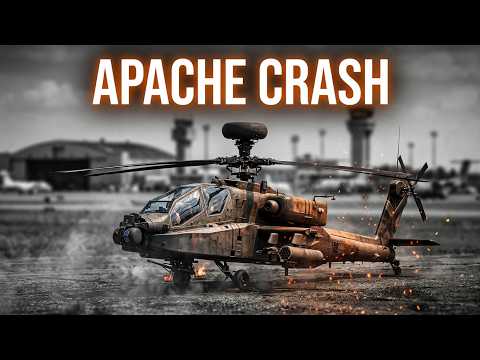 Update 12 Soldiers Killed in Fort Hood Apache Crash Near Salado
 Update 2Apache Maintenance Flight Crashes Near Fort Hood, Killing 2 SoldiersYou are here
 Update 32 Dead in Texas Apache Crash: Who They Were and Why Flights ResumedNewer
 Update 4Army Grounds All Apache Training Flights After Fatal Fort Hood CrashNewer
What changed since our last report
32 hours later
Then
2 Soldiers Killed in Fort Hood Apache Crash Near SaladoStill open then
- No verified cause, engine finding, weather factor, or cockpit record has been disclosed.
- No complete account of fire size, evacuation duration, or property damage is established.
We said we'd watch for
- What Army investigators conclude from secured wreckage and maintenance records.
- Whether the training pause is lifted, extended, or narrowed to specific conditions.
Now
An AH-64E Apache on a maintenance test flight went down near Salado, killing two Fort Hood pilots and forcing evacuations.
Now established
- An AH-64E Apache crashed near Salado at about 1:40 p.m. Aug. 12 during a maintenance test flight.
- Chief Warrant Officer 2 Deontre T. Huey and Warrant Officer Seth L. Olmstead were killed.
- The Army temporarily paused Apache training missions after the crash.
Two is the number that matters here. Two soldiers went up in an Apache attack helicopter over Central Texas for what should have been a contained, professional flight, and neither came home. In Army aviation, where crews train relentlessly to cheat death in combat, two empty chairs in one company room is a scale of loss that everyone in uniform feels immediately, and that two families will feel permanently. 27
The aircraft, an Army AH-64E Apache attack helicopter based at Fort Hood, crashed in a field near Salado, Texas, on Wednesday, Aug. 12, 2026, at approximately 1:40 p.m., killing both soldiers on board. 27 The crash occurred southwest of Salado during what Fort Hood officials later confirmed was a maintenance test flight, a detail that corrects earlier characterizations of the mission as routine training. 37
There were no injuries on the ground, but the impact was violent enough to spark a grass fire in the field where the aircraft went down. 27 The fire prompted the evacuation of several homes in the area while firefighters worked to contain the burn, and a tanker aircraft dumped fire retardant on the field to help stop its spread. 210
Two pilots identified after mishap
The Army identified the two pilots on Friday, Aug. 14, as Chief Warrant Officer 2 Deontre T. Huey, 34, and Warrant Officer Seth L. Olmstead. 5678 Both were assigned to Bravo Company, 1st Battalion, 227th Aviation Regiment, 1st Air Cavalry Brigade, 1st Cavalry Division at Fort Hood. 5678
That assignment places them inside one of the Army's most experienced attack aviation formations. The 1st Air Cavalry Brigade flies the Apache as its core killing machine — a two-seat, heavily armed helicopter built for close combat, reconnaissance and escort — and its warrant officers are typically among the service's most seasoned aviators, selected and trained specifically to fly. 78
Fort Hood's official release described what happened in spare, formal language that the Army uses when it does not yet know why an aircraft fell from the sky. The base said the helicopter experienced a mishap near Salado during the maintenance test flight, resulting in the loss of the two soldiers from Bravo Company, 1st Battalion, 227th Aviation Regiment. 57
A Fort Hood AH-64E Apache attack helicopter experienced a mishap at approximately 1:40 p.m. Aug. 12 near Salado during a maintenance test flight, resulting in the loss of two Soldiers assigned to Bravo Company, 1st Battalion, 227th Aviation Regiment, 1st Air Cavalry Brigade, 1st Cavalry Division
A maintenance test flight is not the same thing as a training sortie, and the distinction matters to investigators even if it can sound bureaucratic from the outside. A training mission is about the crew — practicing tactics, emergency procedures or coordination. A maintenance test flight is about the machine — verifying that an aircraft performs as it should after maintenance has been performed. Fort Hood confirmed the Salado flight was the latter. 37
The confusion is understandable because early accounts, including our own video narration, described it only as a reported training flight. Fox News later framed the crash as occurring during training exercise, while Fort Hood's official release is authoritative that it was a maintenance test flight. 3710 The sources therefore disagree in characterization, with the installation's formal identification of a maintenance test flight carrying the most weight. 3710
Who’s who
- Deontre T. HueyChief Warrant Officer 2, 34, Bravo Company, 1st Battalion, 227th Aviation Regiment
- Seth L. OlmsteadWarrant Officer, Bravo Company, 1st Battalion, 227th Aviation Regiment
What followed the crash followed a familiar and painful pattern. The site had to be secured as a burned field while emergency crews finished the firefight and kept residents clear. 210 No additional injuries on the ground were reported, which, given a helicopter crash that starts a wildfire close enough to homes to force evacuations, reflects both luck and the speed of the local response. 210
The Army temporarily paused Apache helicopter training missions following the crash. 4 Such pauses are not admissions of cause; they are how aviation commanders create space to check the fleet, review procedures and mourn without the pressure of the next takeoff, while a separate investigation works to determine what actually failed. The cause of the crash and any investigation findings have not been detailed beyond that an investigation and cause determination were underway. 4
What investigators must now answer
For now, the public record is thin beyond the essentials: the type of aircraft, the time and general location, the nature of the flight, the names and unit of the dead, the fire and evacuations, and the pause in Apache training missions. 247 The precise location beyond a field southwest of Salado, the exact sequence in the air, and the cause and circumstances have not been released in the sources. 27
That thinness is normal at this stage and it is also unsatisfying, especially for two families who were told on Aug. 14 who they had lost. The Army's identification of Huey and Olmstead, two days after the crash, put names to a mishap notice and returned the story to where it started: with two soldiers who boarded an Apache for a maintenance test flight and did not return. 578
The loss leaves a Fort Hood aviation unit facing two deaths from a flight that was supposed to confirm an aircraft was safe to fly, with a burned field to secure while investigators work to determine the cause. The next facts that matter will not be about terminology, but about mechanics and decisions — what the helicopter did, what the crew faced, and what the Army learns in time to tell the next crew. 37
Known
Unknown
- No cause, mechanical finding, or cockpit sequence has been released.
Next
- Whether investigators identify a mechanical, procedural, or combined cause and what the Army changes as a result.
Sources
11 sources10 outlets1 video
forthoodmediacenter.com1
Fox Newsfoxnews.com1
HeyDay News11 video
Military Timesmilitarytimes.com1
NBC Newsnbcnews.com1
taskandpurpose.com1
The Aviationisttheaviationist.com1
USA TODAYusatoday.com1
Source map
Follow the evidence behind this report. The map shows its connections; the links below open the sources cited in this article.
Source map loads as you read.
Revision log
- r1First published.