Conflict · Gaza food assistanceContinuing story · report 5 of 5
Nearly 500,000 face losing Gaza food aid as WFP funding runs short
WFP attributes the threatened reduction to insufficient funding, not easing hunger. Its figures show a sharp loss of coverage, but the start date and money needed to restore assistance remain unclear.
Transcript · LOADING
Continuing storyDay 80
5 reports56 outlets102 sources5 videos
Full story- No dated events yet
 Update 1Trump claims Hamas disarmament deal, but Hamas conditions it and Israel bails
 Update 2Netanyahu Said No to Trump's 15-Point Gaza Plan, Then Kushner Tried to Revive It
 Update 3Gaza Talks Hit Sequencing Wall as Strikes Continue and Egypt Hosts Signing
 Update 4Gaza’s ceasefire nears a year. The aid keeping families fed is under threat.
 Update 5Nearly 500,000 face losing Gaza food aid as WFP funding runs shortYou are here
What changed since our last report
11 days later
Then
Gaza’s ceasefire nears a year. The aid keeping families fed is under threat.What we said was still open
The exact projected six-month donation gap, current stabilization-force deployment and number of combatants within the death toll remain unestablished.
Still openThe exact six-month donation gap remains unestablished because requirements, available funding and unmet needs have not been separated. The new reporting also does not establish current stabilization-force deployment or the number of combatants within the previously discussed death toll. 15
Watch for a dated negotiation announcement, changes in entry permissions and a funding balance that distinguishes requirements from money still missing.
Still open
Now
WFP attributes the threatened reduction to insufficient funding, not easing hunger. Its figures show a sharp loss of coverage, but the start date and money needed to restore assistance remain unclear.
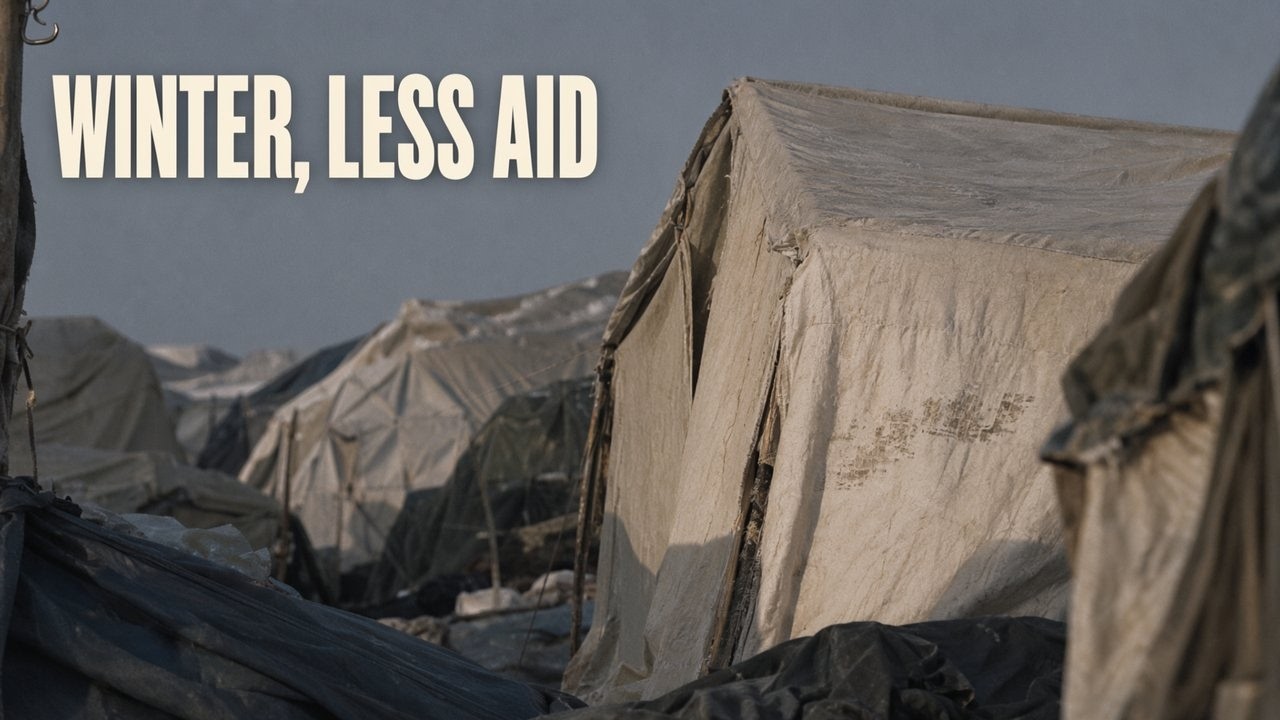
For families approaching winter in makeshift tents, losing food assistance would compound an already precarious existence: inadequate shelter, damaged services and no dependable safety. Nearly half a million people in Gaza now face that loss, according to the World Food Programme—not because hunger has eased, but because the agency is running short of money. 1
Carl Skau, WFP’s acting executive director, described the funding-driven reduction in an October 18, 2026, account carried by the Associated Press. He said bringing food into Gaza had not become more difficult. That distinction matters: the reason he gives for this cut is insufficient funding, not falling need or a new deterioration in food-entry conditions. It does not mean access restrictions have ended. 1 2
On October 8, we reported that Gaza’s food assistance was threatened by inadequate funding and restricted access as the ceasefire approached its first anniversary. The new account makes the financial threat concrete: roughly half a million people stand to lose coverage. What remains unclear is exactly when that reduction takes effect, who loses assistance and what money would restore it.
Fewer recipients, not less hunger
The clearest written measure comes from WFP’s External Situation Report 98, dated October 12 and covering September 1–30. It says funding constraints are forcing monthly assistance in Gaza down from 1.6 million people to 1.1 million. 5
Key facts
That is a reduction of 500,000 people—nearly a third of the stated previous caseload. It is not evidence that everyone remaining on the programme will receive a ration 31.25 percent smaller. The figures count recipients; they do not establish changes in calories, food-parcel contents or distribution frequency for those still receiving help. 5
There is an unresolved discrepancy in the starting total. AP’s syndicated description, published October 18, gives a baseline of 1.8 million and a reduction of at least 500,000, without an exact resulting total. WFP’s October 12 report uses 1.6 million falling to 1.1 million. Different periods or kinds of assistance might explain the difference, but no explanation has been established. The accounts cannot safely be combined into a new total. 7 5
Nor should assistance coverage be confused with the scale of hunger. NPR’s October 18 interview introduction puts the number suffering acute food shortages at an estimated 1.4 million. That is a measure of food need, not another count of WFP recipients. A programme can reach fewer people while hunger remains severe; losing eligibility or coverage does not demonstrate that a household has found enough to eat elsewhere. 3
A separate squeeze is already being described in cash assistance. ReliefWeb’s descriptive text for WFP’s report says funding constraints are forcing lower cash-transfer values for 75,000 Gaza families. The previous and new payments, their start date and their overlap with the half-million-person reduction are not established. Adding those families to the individual beneficiary count would risk counting some people twice. 12
The missing balance behind the cuts
WFP lists US$426 million as needed for operations in Gaza and the West Bank from July through December 2026. That is a combined-territory figure, not a Gaza-only shortfall. The available statement does not separate requirements, contributions already available and the remaining unmet balance—or establish the funding-status date. It therefore cannot be treated as either a verified gross budget or a verified donation gap. 15
This leaves the most practical financial question unanswered: how much additional money would keep the threatened Gaza assistance going? The current evidence establishes neither that sum nor a new funding commitment sufficient to prevent or reverse the reduction. A large appeal number is not a substitute for an accounting of what is available and what is missing.
The timetable is similarly unsettled. A UNifeed item names October 1 as the start of a Gaza food-assistance scale-back, but the available dated material does not establish the year or connect that announcement to the specific 1.6-million-to-1.1-million measure. It cannot confirm implementation on October 1, 2026. There is also no verified end date, restoration schedule or list of affected neighbourhoods and recipient groups. 4 5
Winter meets an unfinished recovery
“Life is absolutely brutal in Gaza,” Skau said, in the line carried by NPR. His current account describes families still living in improvised tents without dependable water, sanitation, basic services or safety. He characterizes the situation as one year into the ceasefire and three years into the war. Those anniversaries do not mean homes have been rebuilt or essential services restored. 3 1
Earlier UN reporting supports the broad picture, while not providing a fresh October assessment. On September 4, the UN Office for the Coordination of Humanitarian Affairs described most of Gaza’s 2.1 million people approaching the rainy season in overcrowded displacement sites. It also described wastewater infrastructure under repair in an area destroyed by hostilities, and children continuing to be killed by airstrikes and other attacks in populated areas. 20
Skau also reports almost 50 security incidents a day. That remains his account: the definition, observation period and underlying incident series are not established here. The figure cannot responsibly be relabelled as 50 daily attacks or ceasefire violations, and it is not a casualty count. The September UN assessment corroborates continuing danger, not that particular daily rate. 1 20
The central development is clear even where the accounting is not: WFP describes a financially driven loss of food coverage while serious need persists. For displaced families facing winter, the unanswered questions are not technical footnotes. They determine whether assistance continues, when it stops and whether there is anything dependable to replace it.
As aired 13 lines
- On October 8, we reported Gaza aid faced cuts. Now WFP says nearly half a million people face losing assistance. Families approach winter in makeshift tents, with hunger still widespread. How much coverage is being lost, and what would restore it?
- Carl Skau, the World Food Programme's acting executive director, says the agency is running short of money. He attributes this reduction to funding, even as food needs persist. He says bringing food into Gaza hasn't become more difficult. Earlier access restrictions also threatened assistance, but money is the reason he gives for this cut.
- An estimated 1.4 million people in Gaza are suffering acute food shortages. That measures the need for food. WFP's assistance figures measure how many people the agency helps. Hunger can remain severe while the programme's ability to reach people shrinks.
- WFP puts its previous monthly coverage at 1.6 million people, falling to 1.1 million. That's 500,000 fewer people, or 31.25 percent of the previous caseload. The percentage measures the reduction in people covered.
- Those figures cover monthly assistance in Gaza. They're dated October 12 and cover September. They give the clearest numerical picture of the contraction, but a different starting total also appears in the current account.
- The starting totals differ. One is 1.6 million people. The other is 1.8 million, with at least 500,000 losing assistance. Both describe a reduction around half a million or more. Nobody has explained the difference between those starting figures.
- WFP also describes lower cash transfers for 75,000 Gaza families as already under way. That reduces how much money those families receive. Some may also be among the people facing loss of monthly assistance, so adding the family count to the beneficiary count would risk counting people twice.
- WFP lists 426 million dollars as needed for operations in Gaza and the West Bank from July through December 2026. It hasn't separated that figure into money available and money still missing, so Gaza's remaining funding gap is unclear.
- The two territories share that funding figure. It can't tell a family in Gaza how much money would keep their assistance going. The amount needed to restore the threatened coverage is still unclear, while winter adds another pressure to daily life.
- Skau says, “Life is absolutely brutal in Gaza.” He describes families living in improvised tents without dependable water, sanitation, basic services or safety. He places those conditions one year into the ceasefire and three years into the war.
- Skau also says Gaza is experiencing almost 50 security incidents a day. He hasn't explained which incidents that includes or how long that rate has held. His description conveys continuing danger for people whose homes and essential services remain damaged.
- By September 4, most of Gaza's 2.1 million people were approaching the rainy season in overcrowded displacement sites. Wastewater infrastructure was being repaired in an area destroyed by hostilities. Children continued to be killed by airstrikes and other attacks in populated areas.
- Those September conditions show the pressures families were already carrying into autumn. Skau's current description adds a threatened loss of food assistance as colder weather approaches. WFP hasn't said when this specific beneficiary reduction takes effect or when coverage could return. There's no confirmed new funding commitment sufficient to prevent or reverse the reduction.
Sources
27 sources15 outlets1 video2 wire copies
ReliefWebreliefweb.int8
- First reported
- WFP Palestine Emergency Response External Situation Report 98, 12 Oct 2026
- WFP Palestine Emergency Response External Situation Report 97, 24 Sep 2026
- WFP Palestine Emergency Response External Situation Report #98, 12 October 2026 (Reporting period: 1-30 September 2026) - occupied Palestinian territory
- WFP Palestine Emergency Response External Situation Report #96, 8 September 2026 (Reporting period: 1-31 August 2026) - occupied Palestinian territory
- WFP Palestine Emergency Response External Situation Report #97, 24 September 2026 (Reporting period: 1-15 September 2026) - occupied Palestinian territory
- WFP Palestine Emergency Response External Situation Report #98, 12 October 2026 (Reporting period: 1-30 September 2026) - occupied Palestinian territory
- WFP Palestine Emergency Response External Situation Report #94, 10 August 2026 (Reporting period: 1-31 July 2026) - occupied Palestinian territory
- WFP PALESTINE EMERGENCY RESPONSE
wfp.org4First
- First reported
- Palestine | World Food Programme
- Funding shortfall forces the World Food Programme to cut food assistance by half in the West Bank | World Food Programme
- Hunger in Gaza: aid delivers fragile gains, but families remain in crisis | World Food Programme
- État de Palestine | World Food Programme
|opale-magazine.com1
Associated Press11 video
- First reported
- Top WFP official describes life in Gaza as 'brutal' amid ongoing food shortages · video
Interactive News111things.com1
- First reported
- Gaza Aid Response Squeezed by Funding and Access Barriers
NBC Newsnbcnews.com1
New Delhi Timesnewdelhitimes.com1
PBS Newspbs.org1
- First reported
- WFP official on addressing global hunger in face of wars ...
The Globe and Mailtheglobeandmail.com1
The Southwest Iowa News Sourceswiowanewssource.com1
UN Newsun.org1
- First reported
- GAZA / FOOD AID FUNDING CUTS | UNifeed
Source map
Follow the evidence behind this report. The map shows its connections; the links below open the sources cited in this article.
Source map loads as you read.
Revision log
- r1First published.