
Economy · 37.5% tariff hitContinuing story · report 2 of 2
Brazil Starts Reciprocity Review Over U.S. Tariffs, Holds Fire
Brasília opened its first case under the 2025 Reciprocity Law over July U.S. duties — a formal review, not retaliation yet, with the headline rate itself in dispute.
Transcript · LOADING
Continuing storyDay 24
2 reports15 outlets22 sources2 videos
Full story
What changed since our last report
23 days later
Then
60 Countries, Two Tiers, One Friday Deadline: The New Tariff MapStill open then
- Whether a separate 50% Section 338 tariff on Canada, with a 30-day negotiation window for Prime Minister Mark Carney, is in effect.
- Whether a CNN poll showing 63% opposition (up from 48% in November) reflects current public opinion.
- Which specific product categories — beyond the general forced-labor framing — are exempted from the new duties.
We said we'd watch for
- How trading partners respond in formal filings and at the WTO before Friday's deadline.
- Whether the lower-tier headcount settles at 14, 16, 17 or another number as more documentation is published.
- How quickly the new rates pass through to consumer prices on the next import cycle.
Now
Brasília opened its first case under the 2025 Reciprocity Law over July U.S. duties — a formal review, not retaliation yet, with the headline rate itself in dispute.
Now established
- Brazil opened a reciprocity review August 13-14 over July U.S. tariffs, with no countermeasures imposed yet.
- The 2025 Reciprocity Law allows mirror measures and suspension of concessions, now used for the first time.
- Brasília describes the move as a negotiation tool to force talks on technical criteria.
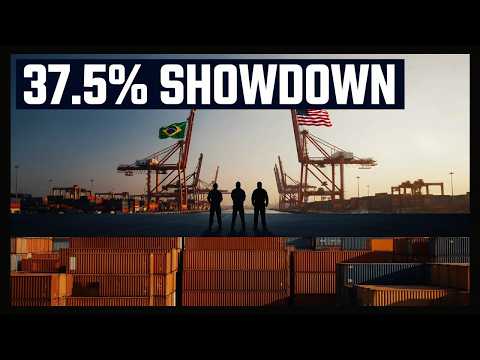
37.5% is the number hanging over this fight — or 25%, depending on which newsroom you ask. The Associated Press confirms American duties on hundreds of Brazilian exports as "reaching up to 37.5%" 2, while Valor International describes the July action by President Donald Trump as a "25% tariff on Brazilian exports" 3. That gap is not a rounding error. It is the first sign of how fast, and how politically, this tariff dispute is being narrated on both sides of the equator.
What is not in dispute is that Brazil has now answered with process. On August 13-14, 2026, Brazil formally opened a case under its Economic Reciprocity Law in response to the U.S. tariffs imposed in July on hundreds of Brazilian exports 234. No counter-tariff has been announced, no American product has yet been hit, and no timetable has been published. Brasília has started the clock, not fired the shot.
The sequence matters because the two governments are telling two different stories about why tariffs exist at all. The Trump administration has accused Brazil of unfair trade practices 2. President Luiz Inácio Lula da Silva denies those accusations, insisting they are politically motivated ahead of Brazil's October election 2. Brazil's top diplomat had already called the July tariffs "unjust and politically motivated" and threatened reciprocal measures 92.
By mid-August, that threat became paperwork. A presidential palace statement said the process began after the executive secretariat of Camex, Brazil's foreign trade chamber, shared the request with other bodies 67. G1 also dates the initiation to Thursday the 13th 78, with published coverage following on August 14-15, 2026 2345. In other words, this was an interagency referral turned into a presidential decision within a day.
First use of a 2025 law
The instrument Lula reached for is new. The Economic Reciprocity Law, approved unanimously in Congress in 2025, allows Brazil to apply the same measures, restrictions, or tariffs it suffers, and to suspend trade concessions 7810. This is the first use of the mechanism 10. That novelty explains both the attention in Brasília and the caution: officials are operating a law that has never been road-tested against the country's second-largest trading partner.
The law does not require instant mirroring. It opens a review that "could lead to countermeasures" 34. Valor similarly reports the government "seeks diplomatic talks" as the review begins 3, and Wion reports Lula activated the law "while stopping short of immediate countermeasures" and seeks negotiations 4. The distinction is central to understanding the week: invocation is not imposition.
Negotiation tool, not retaliation yet
Inside Brasília, officials want that point understood. Via reporting by G1's Andréia Sadi, Brazilian government officials describe the invocation as "instrumento de negociação" — a negotiation tool, not immediate retaliation, aimed at pushing Washington back to talks on technical and commercial criteria 11. In that telling, the dispute is under the command of Secretary of State Marco Rubio on the American side and is crossed by the Brazilian election calendar 11.
That electoral lens is also how the story is being framed abroad. The AP framing presents the move as "in effort to show strength" ahead of the October vote, a line carried in the headline of AP's report by Mauricio Savarese 25. The implication is not subtle: Lula cannot afford to look passive under American tariffs two months before Brazilians vote, even if his economists would prefer a negotiated landing.
There is a strategic logic to starting a formal process rather than announcing tariffs overnight. A review creates leverage without immediate cost to Brazilian importers, gives exporters hit by the July duties a sign the state is responding, and gives Washington a window to negotiate before mirror measures are chosen. Whether that window is real or performative will depend on what Camex and other agencies put on paper next — and none of the provided sources spell out specific Brazilian countermeasures, their timeline, Washington's response, or the economic impact on export sectors.
For now, exporters living under those hundreds of tariff lines remain in limbo. The research file does not detail which Brazilian export sectors are affected or their economic losses, and the sources do not quantify damage beyond the headline rates that themselves disagree 23. That absence matters: without sector data, it is impossible for a reader to judge who is hurting, how much, and whether reciprocity would help them or simply spread the pain to Brazilian consumers of American goods.
The honest way to read August 13-14, then, is as a legal marker with political timing. Brazil has, for the first time, switched on a unanimous 2025 law built for exactly this moment 7810. It has not yet decided what to do with it. The coming weeks will show whether the reciprocity file becomes a bargaining table or a tariff war, and whether the numbers at the top — 37.5% or 25% — converge into a single, verifiable cost.
Known
- Brazil opened a reciprocity review August 13-14 over July U.S. tariffs, with no countermeasures imposed yet. 234
- The 2025 Reciprocity Law allows mirror measures and suspension of concessions, now used for the first time. 7810
- Brasília describes the move as a negotiation tool to force talks on technical criteria. 11
Unknown
- No specific Brazilian countermeasures, timeline, U.S. response, or sector-level economic impact is established in these sources.
- No agreed headline U.S. tariff rate is established because sources report different figures.
Next
- Watch what measures Camex proposes, whether Washington returns to talks, and how the October election shapes Lula's next step.
Sources
11 sources6 outlets1 video1 wire copy
O Globoglobo.com5
- Brazil starts process for possible retaliation against U.S. tariffs
- Lei da Reciprocidade: Brasil inicia processo contra tarifas dos EUA | G1
- O que é a Lei da Reciprocidade Econômica, que Brasil aciona contra os EUA | G1
- Brasil inicia processo de reciprocidade contra tarifaço dos EUA; o que acontece agora
- Governo vê Lei da Reciprocidade como instrumento de negociação com EUA | G1
HCNTimes.comhcntimes.com1
HeyDay News11 video
Source map
Follow the evidence behind this report. The map shows its connections; the links below open the sources cited in this article.
Source map loads as you read.
Revision log
- r1First published.