Politics · Provincial takeover
Pakistan takes control of PTI-led province, with takeover terms still unresolved
Presidential approval displaces Khyber Pakhtunkhwa’s elected administration. The security justification is clear; the full takeover terms, court challenge and parliamentary process are not.
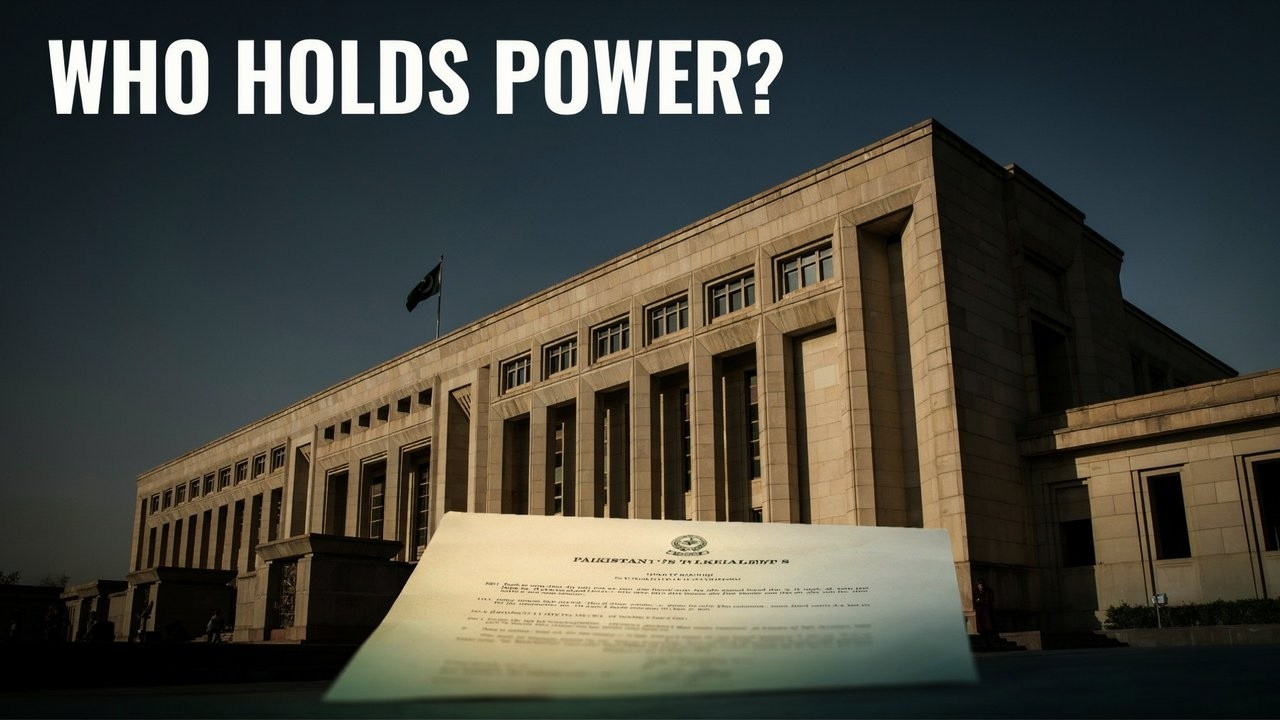
Transcript · LOADING
Story trackerDay 7
1 report36 outlets73 sources
- No dated events yet

Pakistan’s confrontation with Imran Khan’s party has moved from a march toward Islamabad and threats of federal intervention to the displacement of an elected provincial government. On October 11, 2026, President Asif Ali Zardari approved emergency and governor’s rule in Khyber Pakhtunkhwa, taking the struggle over security policy and political authority into a new phase: federal control of the opposition-governed province. 3 17 43
Zardari signed Prime Minister Shehbaz Sharif’s advice under Articles 232 and 234 of the Constitution. APP corroborated the approval through a President Secretariat Media Wing announcement whose wording is clear about the decision, though not its detailed implementation. 17
The President approved and signed the summary upon the Prime Minister’s advice under Articles 232 and 234 of the Constitution of Pakistan.
According to the Radio Pakistan account, the arrangement removes Chief Minister Sohail Afridi and provincial ministers, advisers, special assistants and the advocate general. Governor Faisal Karim Kundi is to administer the province under federal direction. The provincial assembly reportedly survives, but its law-making powers pass to Pakistan’s national Parliament. Keeping the assembly in existence is not the same as keeping its elected members in control. 1
The complete operative proclamation or notification was not available for inspection. That does not undo the confirmed presidential announcement; it limits what can be established about the transfer of powers, territorial coverage, commencement and expiry. Reports describe immediate effect, but the detailed administrative arrangements and consequences for everyday services remain unresolved. 17 42
This is a change in government for a province of roughly 40.8–40.9 million people in 2023, not a measured October 2026 population. City Population’s census summary gives 40,856,097, including tribal districts; Dawn’s August 13, 2023 report rounded it to 40.8 million. An official PBS table gives 40,641,120. The unexplained difference cautions against presenting either as an exact current count. 57 58 59
The decision outruns its published detail
The reported initial term is two months, extendable through a joint sitting of Parliament to six months total. Neither a verified commencement clause nor a calendar expiry date has been established. Those reported limits should not be turned into an assumed deadline, and no extension has been confirmed. 1
Article 233 powers to suspend fundamental rights are reportedly unused. That distinction matters: emergency, governor’s rule and suspension of rights are not interchangeable. But omission of Article 233 from the short presidential announcement is not independent proof that no separate order exists. Nor would its non-use mean that other restrictions on gatherings have disappeared. 1 17
The approval supersedes the October 10 position, when Tarar confirmed that the cabinet would discuss the options and Kundi said no final decision had been made. Aaj and 24NewsHD subsequently reported cabinet agreement, citing sources, before presidential approval was established. These are successive reporting stages, not competing accounts of the final outcome. Publication and update times do not establish a reliable minute-by-minute decision chronology. 3 2 7 25 17
A security case, not a result
Federal officials point to deteriorating security and disagreement with the provincial government over counterterrorism policy. Interior Minister Mohsin Naqvi said there was “no room left” to avoid an emergency. That is the government’s argument for necessity, not an independently demonstrated finding that removing the provincial administration was the only available response. 20 14
Aaj relayed intelligence-report figures of a 195% increase in terrorist incidents from March 2024 to September 23, 2026; 73% of 2026 attacks targeting police and security forces; 170 militant drone attacks in 2026; and more than 9,000 vacant police posts. Dunya separately corroborated that police and intelligence presentations asserted a 195% increase “over the past two years.” 2 49
These remain reported agency figures, not independently audited measurements. The incident comparison lacks baseline counts and methodology; the target share lacks a verified denominator and classification; the drone count lacks a clear cutoff and counting definition; and the vacancies lack confirmed staffing totals, scope and reference date. They describe different problems and cannot be combined into one measure of danger. 2 49
An earlier proposal covered 12 districts, described in further reporting as eight merged tribal districts plus Dera Ismail Khan, Tank, Bannu and Lakki Marwat. The other eight names and final operative emergency coverage have not been established. A district-level proposal cannot settle the territorial reach of the final instrument. 2 50
The vacancy claim poses a practical test alongside the constitutional fight. Changing who governs does not fill police posts, equip officers or establish better protection for communities. No verified staffing expansion or reduction in violence resulting from the takeover has yet been demonstrated.
PTI calls the measures an attack on the province’s mandate and says it will challenge them in court. Chairman Gohar Ali Khan called the emergency an “undemocratic move” and demanded reversal. An announced intention to litigate is not a filed case: no court, filing date, hearing or injunction has been established. 2 1 70
The confrontation also surrounds PTI’s march demanding Imran Khan’s release. Before the takeover, Afridi warned of mass mobilization; provincial police were reportedly told to prepare for violent protests. Neither warning establishes that violence occurred. In neighboring Rawalpindi district, gatherings of five or more are reportedly prohibited through November 8—a restriction relevant to the march, not a KP-wide order. 68 3
Reports that Afridi and PTI provincial president Junaid Akbar were arrested remain unconfirmed by police. Removal from office must not be confused with detention. Kundi’s warning that Afridi would face arrest if he took illegal action at Governor House was conditional, not confirmation of custody. 1 24
The next reported parliamentary date is October 13, with separate National Assembly and Senate sessions scheduled. No official summons, agenda or joint-sitting notice was available to verify the particulars. Separate meetings are not themselves a joint sitting. 2 27
Dawn and Business Recorder’s earlier legal summaries describe a ten-day referral requirement when the president issues a proclamation on his own. This action followed prime-ministerial advice; that conditional rule cannot silently become a verified deadline for this case. The complete applicable provisions and filing record are still needed. 5 9
Federal authorities have secured presidential approval. What comes next must be judged through the full orders, actual administration, parliamentary scrutiny and any filed court challenge—not through an assumed security improvement or a premature declaration that the dispute over the province’s mandate is settled.
Sources and supporting public records
Approval coverage includes Radio Pakistan’s signing and submission reports 1 16, APP 17, Dunya 18, Express Tribune 19, Aaj Urdu 21, Neo News 22, Nawaiwaqt 23, Dawn’s approval report 41, Daily Times 42, AP 43, Tribune International 45, Lord Media 71 and KSAT 72.
Preparatory coverage includes Aaj English’s decision reports and meeting report 2 51 48, Geo 3, Dawn’s presidential meeting, advance coverage and submission versions 4 5 10 25 46, Express Tribune 6, 24NewsHD 7, Daily Pakistan 8, Business Recorder’s two supplied addresses 9 12, and The News 11 27.
Legal references include Dawn 20, The News 28, 24NewsHD 29, Samaa 30, Express Tribune 31, The Nation 32, Pakistanconstitutionlaw 33, AsianLII 26, CommonLII 35, Pakistani.org 36 40, National Assembly documents 34 37 38, Pakera 39, Daily Pakistan 65, ABCNews.com.pk 66 and Pakistan Connect 67.
As aired 27 lines
- Pakistan’s federal government has displaced Khyber Pakhtunkhwa’s elected provincial administration.
- The takeover changes who runs a province with about 40.8 million people in the 2023 census. Provincial power shifts toward federal authorities without an intervening provincial election.
- How will federal control be exercised, and who will scrutinize it?
- President Asif Ali Zardari signed Prime Minister Shehbaz Sharif’s advice on October 11, 2026. The government invoked Article 232 for emergency and Article 234 for governor’s rule, two constitutional mechanisms with different requirements and consequences.
- The president’s office confirmed the approval and signing. The measures reportedly take immediate effect. But the full legal terms are still needed to pin down how the takeover works, including its territorial reach and exact expiry.
- Governor Faisal Karim Kundi had said on October 10 that no final decision had been made. Information Minister Attaullah Tarar confirmed that the cabinet would discuss the options the next morning. The cabinet then recommended the measures, and Zardari approved them.
- The arrangement reportedly removes Chief Minister Sohail Afridi and puts Governor Faisal Karim Kundi in charge under federal direction. Afridi’s party, Pakistan Tehreek-e-Insaf, or PTI, loses control of the provincial administration.
- The removals also cover provincial ministers, advisers, special assistants and the advocate general. Dr Muhammad Fakhar Alam Irfan is reportedly the incoming chief secretary, the province’s senior administrative official. Residents now face a change in who directs their government.
- The provincial assembly reportedly remains in place, while its law-making powers pass to Pakistan’s national Parliament. The initial term is reported as two months, with extension through a joint sitting possible up to six months total.
- The exact expiry date is still unclear. Article 233 powers to suspend fundamental rights are reportedly unused. The full orders are needed to settle the rights position, and existing restrictions on gatherings can continue under other powers.
- Interior Minister Mohsin Naqvi said there was “no room left” to avoid an emergency. The federal government points to deteriorating security and its disagreement with the provincial government over counterterrorism policy as reasons for taking control.
- Naqvi’s statement makes the government’s case for necessity. Whether replacing the provincial administration improves security will depend on what the new administration actually does, including police staffing and resources.
- An earlier proposal covered 12 districts, described as eight merged tribal districts plus Dera Ismail Khan, Tank, Bannu and Lakki Marwat. That proposed coverage still needs to be checked against the final emergency terms.
- Police and intelligence presentations claim terrorist incidents rose 195 percent over about two years. The cited comparison runs from March 2024 to September 23, 2026. They also put police and security forces at 73 percent of 2026 attack targets.
- The incident totals behind that increase haven’t been released, so the calculation can’t be checked. The attack-target share also lacks a clear total and classification rules. Those gaps limit what the percentages can tell us about the scale of violence.
- The security figures also include 170 militant drone attacks in 2026 and more than 9,000 vacant police posts. The drone count’s cutoff and the staffing count’s scope are unclear. These measure different problems and can’t be added together.
- Federal authorities haven’t yet shown that the takeover has filled those vacancies or reduced violence. The staffing claim puts a practical challenge alongside the constitutional fight: communities still need enough trained and equipped police to protect them.
- The whole-province census comparison lists 35,501,964 people in 2017 and 40,856,097 in 2023, including tribal districts. Another official census table gives 40,641,120. These are historical counts, rather than a population measurement taken during this takeover.
- The two 2023 totals differ by 214,977 people, with no explanation yet for the discrepancy. The defensible scale is roughly 40.8 to 40.9 million people in 2023, whose provincial governing arrangements are now changing.
- PTI chairman Gohar Ali Khan called the emergency an “undemocratic move.” He demanded immediate reversal and warned of political and economic damage. PTI says it will challenge the takeover in court as an attack on the province’s mandate.
- No court filing or ruling has been confirmed yet. Before the takeover, Afridi warned of mass mobilization and said detention of parliamentarians wouldn’t stop people joining PTI’s march. The provincial police chief reportedly told district police to prepare for violent protests.
- More than 5,000 supporters began marching toward Islamabad on October 5 after government–PTI talks collapsed. They demanded Imran Khan’s release. Authorities blocked roads and warned of consequences. That earlier participation figure doesn’t tell us today’s turnout.
- In neighboring Rawalpindi district, gatherings of five or more people are reportedly prohibited through November 8. That restriction affects the march’s surroundings. Afridi’s warning and the police preparations describe the prospect of unrest, without confirming that violence has occurred.
- Police haven’t confirmed claims that Afridi and PTI provincial president Junaid Akbar were arrested. Kundi had warned that Afridi would face arrest if he took illegal action at Governor House. His warning was conditional.
- Federal authorities have secured approval to displace the provincial government. How they exercise that authority now depends on the detailed orders and transfer of administration. Parliament and any court challenge will provide the next tests of the takeover’s terms.
- The National Assembly and Senate are reportedly scheduled to meet separately on October 13. Whether a joint sitting will also take place is still unclear. A joint sitting would bring both houses together for the reported extension process.
- A ten-day referral rule has also been cited for a proclamation issued by the president on his own. This action followed the prime minister’s advice, and the exact parliamentary process still needs clarification. October 13 is the next reported opportunity for parliamentary scrutiny.
Sources
73 sources36 outlets1 wire copy
Dawndawn.com9
- First reported
- PM Shehbaz meets President Zardari as Centre mulls imposition of emergency in KP
- Emergency looms over KP as Centre-PTI rift widens
- Emergency looms over KP as Centre-PTI rift widens
- Governor’s rule and emergency imposed in KP — here’s what it means - Pakistan - DAWN.COM
- Federal cabinet gives nod to imposition of emergency in KP; summary sent to President - Pakistan - DAWN.COM
- Emergency, governor's rule imposed in KP as president approves cabinet decision - Pakistan - DAWN.COM
- Federal cabinet gives nod to imposition of emergency in KP; summary sent to President - Pakistan - DAWN.COM
- Census puts KP’s population at 40.8m - Pakistan - DAWN.COM
- CM Afridi says will not accept 'illegal move' of governor's ...
Pakistan Bureau of Statisticspbs.gov.pk7
- TABLE 1 : AREA, POPULATION BY SEX, SEX RATIO, POPULATION DENSITY, URBAN POPULATION, HOUSEHOLD SIZE AND ANNUAL GROWTH RATE, CENSUS-2023, KHYBER PAKHTUNKHWA
- 7 Population and Housing Census-2023
- ALL LOCALITIES
- Provincial%20census%20report%202023 kp.pdf
- www.pbs.gov.pk
- TABLE 14 : TOTAL POPULATION, EMPLOYMENT BY GENDER AND RURAL/URBAN, CENSUS-2023
- TABLE 2 : URBAN LOCALITIES BY POPULATION SIZE AND THEIR POPULATION BY SEX, ANNUAL GROWTH RATE AND HOUSEHOLD SIZE CENSUS-2023 KHYBER PAKHTUNKHWA
Aaj English TVaaj.tv4
- First reported
- Pakistan moves toward emergency and governor’s rule in Khyber Pakhtunkhwa
- صدرِ مملکت نے خیبرپختونخوا میں گورنر راج اور ایمرجنسی کے نفاذ کی سمری پر دستخط کردیے - Pakistan - AAJ
- Cabinet meeting underway to consider KP emergency measures - Pakistan
- Cabinet decides to impose emergency, governor’s rule in KP: Sources - Pakistan
Daily Pakistan English Newsdailypakistan.com.pk4
- First reported
- KP faces emergency, governor's rule at the same time amid political, security crisis
- KP Emergency and PTI Long March: Live Updates
- How Long Can Governor’s Rule Last in KP as Pakistan’s Constitution sets 6-Month Limit
- PTI Chairman Barrister Gohar warns of ‘Serious Consequences’ over KP Emergency
The Express Tribunetribune.com.pk3
X (formerly Twitter)x.com3
- First reported
- @SammerAbbas post
- @humnews_english post
- @BedariDigital post
Associated Press of Pakistanapp.com.pk2
Brecorderbrecorder.com2
Daily Timesdailytimes.com.pk2
Radio Pakistanradio.gov.pk2
The Nationnation.com.pk2
ABC News: Breaking News in Pakistan & World Todayabcnews.com.pk1
- First reported
- Governor's rule or emergency?
asianlii.org1
Build Better Pakistanbuildbetterpakistan.com1
Click Pakistanclickpakistan.com.pk1
commonlii.org1
Geo Newsgeo.tv1
- First reported
- Federal govt decides to impose emergency in KP: sources
kashmirenglish.comkhyberchronicles.pk1
KSATksat.com1
Lord Media Networklord.pk1
Nawaiwaqtnawaiwaqt.com.pk1
NEO TV | Voice of Pakistanneonews.pk1
Pakistan Erapakera.pk1
- First reported
- Article 232 Emergency and Governor's Rule in Pakistan
pakistanconstitutionlaw.com1First
SAMAA TVsamaa.tv1
- First reported
- Governor’s Rule in KP: What Constitution says
The Tribune Internationalthetribuneinternational.com1
- First reported
- Federal government imposes emergency, governor’s rule in KP
Source map
Follow the evidence behind this report. The map shows its connections; the links below open the sources cited in this article.
Source map loads as you read.
Revision log
- r1First published.